Richard Holmes CBE TD JP
The Project Chairman standing by Hougoumont's North Gate
May 2007
The Project Chairman standing by Hougoumont's North Gate
May 2007
Welcome to Project Hougoumont
Project Hougoumont is heritage project to save the
Hougoumont Farm on the site of the 1815 Battlefield of
Waterloo in Belgium. Its aim is to ensure that the site
is sound and intact for the long–term future, with a view
to attracting and educating more visitors
An introduction by Professor Richard Holmes CBE TD JP
The farm complex of Hougoumont, now known as Goumount, stood just in front of the Allied right centre at the battle of Waterloo on 18 June 1815. It was repeatedly and gallantly attacked by the French throughout that long and bloody day, and, although some of the assailants actually broke into the inner courtyard and the main chateau was burnt down, the garrison hung on to the surviving buildings. This garrison was itself a microcosm of the Duke of Wellington's army. There were British foot guards, a Netherlands Nassau battalion, German regulars and militiamen, as well as regulars of the King's German legion, supported by British and German gunners, with, let it not be forgotten, a private of the Royal Wagon Train delivering, under fire, the ammunition upon which the defence depended. Wellington later affirmed that 'the outcome of the Battle of Waterloo rested upon the closing of the gates of Hougoumont.' I have spent much of my professional life walking the battlefields of the world, and there are few spots on any field that have the resonance of this haunted spot.

The Chapel seen through Hougoumont's North Gate
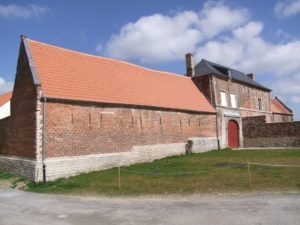
The haunted acres of Hougoumont have certainly not been immune to change. For instance, the chateau itself was burnt down in the fighting; the wood to the south of the complex has long gone, and the great orchard which once stood to the east of the formal garden has now been swallowed up by farmland. However, the traveller approaching Hougoumont from the north, dropping down from Wellington's main position on the ridge, can still see the re–roofed Great Barn and the crucial North Gate, now somewhat changed, but still somehow redolent of that desperate fight. The track leads the visitor on along the western wall of the Great Barn to the farmer's house and the south gate, another area that saw fierce fighting, as the plaque commemorating Général de Brigade Bauduin, killed in the first French attack, testifies. Most of the warm old brickwork surrounding what was the formal garden in 1815 survives, still loopholed for defence. There are several memorials dotted about, commemorating units and individuals who fought there.
Throughout its long life Hougoumont was a working farm, and throughout the years that I have known the place visitors were able to enter to visit the chapel, walk in the paddock that has replaced the formal garden, and generally muse at a spot that has seen so much. The last farmer died some years ago, and the complex was purchased from its owner by the Intercommunale (1815), the body representing the local authorities whose borders meet on the battlefield. A wholesale reorganisation of the central part of the battlefield is currently projected, although the whole process will inevitably, with the best will in the world, take some time.

Hougoumont seen from the eastern wall of what was the Formal Garden
The genesis of Project Hougoumont is the recognition that, as far as Hougoumont is concerned, time is running out fast. The walls of the Great Barn have had a tendency to bulge outwards for many years, and the process has evidently become much more marked of late. The loopholed brick wall surrounding what is now the paddock has been gapped in several places, leaving holes wide enough for vehicles to pass through, and although work has recently begun on refurbishing the chapel, the whole place is increasingly ramshackle and dilapidated. Each passing winter brings the risk of more damage through the penetration of water and frost. Instead of being a focal point of a battle that marked, as Winston Churchill would have put it, a punctuation mark in the history of the world, Hougoumont looks increasingly like a half–forgotten rural building site.
Project Hougoumont seeks to raise funds over the period 2008–2015 for the sympathetic restoration of this most iconic of spots. In doing so it cheerfully acknowledges that the area is owned by the Intercommunale (1815), whose own efforts are fundamental to the redevelopment of the wider site. However, it is evident that the funds at the disposal of the Intercommunale (1815) will not at this time permit it to undertake the work that is so urgently required. The fact that repairs on the chapel have now begun reflects the financial support offered for this specific part of the broader scheme by another voluntary body. A plan for overall restoration has been produced by a Belgian architect commissioned by the Intercommunale, and Project Hougoumont proposes to provide money which will enable this plan to be completed. There are inevitably complex bureaucratic considerations. Planning permission is required, and all work, quite properly, must be of a standard approved by the appropriate authority. A Regional government grant of up to 60% is available for some aspects of the work, although the grant is conditional upon the balance of funds being provided from another source.

The Lion Mound seen through the hole in the southern wall of what was Hougoumont's Formal Garden
When Project Hougoumont begins its formal fund–raising in the autumn of 2008 the monies raised will go to the Charities Aid Foundation in the UK, and will then be passed, as the need arises, to the King Baudoin Foundation. The Project Hougoumont account with this body will be managed by a committee with an even balance of British and Belgian members, and Baron Georges Jacobs de Hagen CBE has kindly agreed to chair it. Money from this account will be used to pay for agreed works. While the precise extent and sequencing of individual elements of the work within the overall plan has yet to be agreed (for much will depend upon on our success in generating cash–flow), Project Hougoumont hopes to see the site both restored and enhanced, so that by the time of the 200th anniversary of the battle visitors are able to gain safe access, interpret what they see, and understand the significance of Hougoumont. The project would also include the constitution of a memorial. Several issues, like the sensitive use of the site by re–enactors (who have traditionally camped in the paddock), the insertion of some form of visitor's centre into the Great Barn are currently under discussion.
The activities of Project Hougoumont are being conducted within the broad umbrella of Waterloo 200, the UK committee which formally provides the focal point for all organisations seeking to participate in bicentennial events. The members of this committee are all clear that we are celebrating the brave men of all sides, not just the British, and examining the battle and its impact not only upon Europe but upon the rest of the world as well. We of Project Hougoumont do not simply remember the British element of its garrison, but applaud the courage of the German and Netherlands infantry in the wood in front of it, and in its grounds, and of the brave Frenchmen who came so close to taking it and turning the fortunes of the day. This is not simply a question of national pride or regimental commemoration. It is about saving a fundamental part of world history, and we simply must not fail.
Project Hougoumont is heritage project to save the
Hougoumont Farm on the site of the 1815 Battlefield of
Waterloo in Belgium. Its aim is to ensure that the site
is sound and intact for the long–term future, with a view
to attracting and educating more visitors
An introduction by Professor Richard Holmes CBE TD JP
The farm complex of Hougoumont, now known as Goumount, stood just in front of the Allied right centre at the battle of Waterloo on 18 June 1815. It was repeatedly and gallantly attacked by the French throughout that long and bloody day, and, although some of the assailants actually broke into the inner courtyard and the main chateau was burnt down, the garrison hung on to the surviving buildings. This garrison was itself a microcosm of the Duke of Wellington's army. There were British foot guards, a Netherlands Nassau battalion, German regulars and militiamen, as well as regulars of the King's German legion, supported by British and German gunners, with, let it not be forgotten, a private of the Royal Wagon Train delivering, under fire, the ammunition upon which the defence depended. Wellington later affirmed that 'the outcome of the Battle of Waterloo rested upon the closing of the gates of Hougoumont.' I have spent much of my professional life walking the battlefields of the world, and there are few spots on any field that have the resonance of this haunted spot.

The Chapel seen through Hougoumont's North Gate
The haunted acres of Hougoumont have certainly not been immune to change. For instance, the chateau itself was burnt down in the fighting; the wood to the south of the complex has long gone, and the great orchard which once stood to the east of the formal garden has now been swallowed up by farmland. However, the traveller approaching Hougoumont from the north, dropping down from Wellington's main position on the ridge, can still see the re–roofed Great Barn and the crucial North Gate, now somewhat changed, but still somehow redolent of that desperate fight. The track leads the visitor on along the western wall of the Great Barn to the farmer's house and the south gate, another area that saw fierce fighting, as the plaque commemorating Général de Brigade Bauduin, killed in the first French attack, testifies. Most of the warm old brickwork surrounding what was the formal garden in 1815 survives, still loopholed for defence. There are several memorials dotted about, commemorating units and individuals who fought there.
Throughout its long life Hougoumont was a working farm, and throughout the years that I have known the place visitors were able to enter to visit the chapel, walk in the paddock that has replaced the formal garden, and generally muse at a spot that has seen so much. The last farmer died some years ago, and the complex was purchased from its owner by the Intercommunale (1815), the body representing the local authorities whose borders meet on the battlefield. A wholesale reorganisation of the central part of the battlefield is currently projected, although the whole process will inevitably, with the best will in the world, take some time.

Hougoumont seen from the eastern wall of what was the Formal Garden
The genesis of Project Hougoumont is the recognition that, as far as Hougoumont is concerned, time is running out fast. The walls of the Great Barn have had a tendency to bulge outwards for many years, and the process has evidently become much more marked of late. The loopholed brick wall surrounding what is now the paddock has been gapped in several places, leaving holes wide enough for vehicles to pass through, and although work has recently begun on refurbishing the chapel, the whole place is increasingly ramshackle and dilapidated. Each passing winter brings the risk of more damage through the penetration of water and frost. Instead of being a focal point of a battle that marked, as Winston Churchill would have put it, a punctuation mark in the history of the world, Hougoumont looks increasingly like a half–forgotten rural building site.
Project Hougoumont seeks to raise funds over the period 2008–2015 for the sympathetic restoration of this most iconic of spots. In doing so it cheerfully acknowledges that the area is owned by the Intercommunale (1815), whose own efforts are fundamental to the redevelopment of the wider site. However, it is evident that the funds at the disposal of the Intercommunale (1815) will not at this time permit it to undertake the work that is so urgently required. The fact that repairs on the chapel have now begun reflects the financial support offered for this specific part of the broader scheme by another voluntary body. A plan for overall restoration has been produced by a Belgian architect commissioned by the Intercommunale, and Project Hougoumont proposes to provide money which will enable this plan to be completed. There are inevitably complex bureaucratic considerations. Planning permission is required, and all work, quite properly, must be of a standard approved by the appropriate authority. A Regional government grant of up to 60% is available for some aspects of the work, although the grant is conditional upon the balance of funds being provided from another source.

The Lion Mound seen through the hole in the southern wall of what was Hougoumont's Formal Garden
When Project Hougoumont begins its formal fund–raising in the autumn of 2008 the monies raised will go to the Charities Aid Foundation in the UK, and will then be passed, as the need arises, to the King Baudoin Foundation. The Project Hougoumont account with this body will be managed by a committee with an even balance of British and Belgian members, and Baron Georges Jacobs de Hagen CBE has kindly agreed to chair it. Money from this account will be used to pay for agreed works. While the precise extent and sequencing of individual elements of the work within the overall plan has yet to be agreed (for much will depend upon on our success in generating cash–flow), Project Hougoumont hopes to see the site both restored and enhanced, so that by the time of the 200th anniversary of the battle visitors are able to gain safe access, interpret what they see, and understand the significance of Hougoumont. The project would also include the constitution of a memorial. Several issues, like the sensitive use of the site by re–enactors (who have traditionally camped in the paddock), the insertion of some form of visitor's centre into the Great Barn are currently under discussion.
The activities of Project Hougoumont are being conducted within the broad umbrella of Waterloo 200, the UK committee which formally provides the focal point for all organisations seeking to participate in bicentennial events. The members of this committee are all clear that we are celebrating the brave men of all sides, not just the British, and examining the battle and its impact not only upon Europe but upon the rest of the world as well. We of Project Hougoumont do not simply remember the British element of its garrison, but applaud the courage of the German and Netherlands infantry in the wood in front of it, and in its grounds, and of the brave Frenchmen who came so close to taking it and turning the fortunes of the day. This is not simply a question of national pride or regimental commemoration. It is about saving a fundamental part of world history, and we simply must not fail.
Make a donation to
Project Hougoumont
today...
DONATE HERE
Project Hougoumont
is an affiliate of
Waterloo 200, the
official Government
approved umbrella
organisation tasked
with the role of
overseeing the 200th
anniversary of the
Battle of Waterloo
of 1815
Project Hougoumont
today...
DONATE HERE
Project Hougoumont
is an affiliate of
Waterloo 200, the
official Government
approved umbrella
organisation tasked
with the role of
overseeing the 200th
anniversary of the
Battle of Waterloo
of 1815
© 2007–8 Project Hougoumont & Frank Toogood Website by
typonic